Element Name: Phosphorus
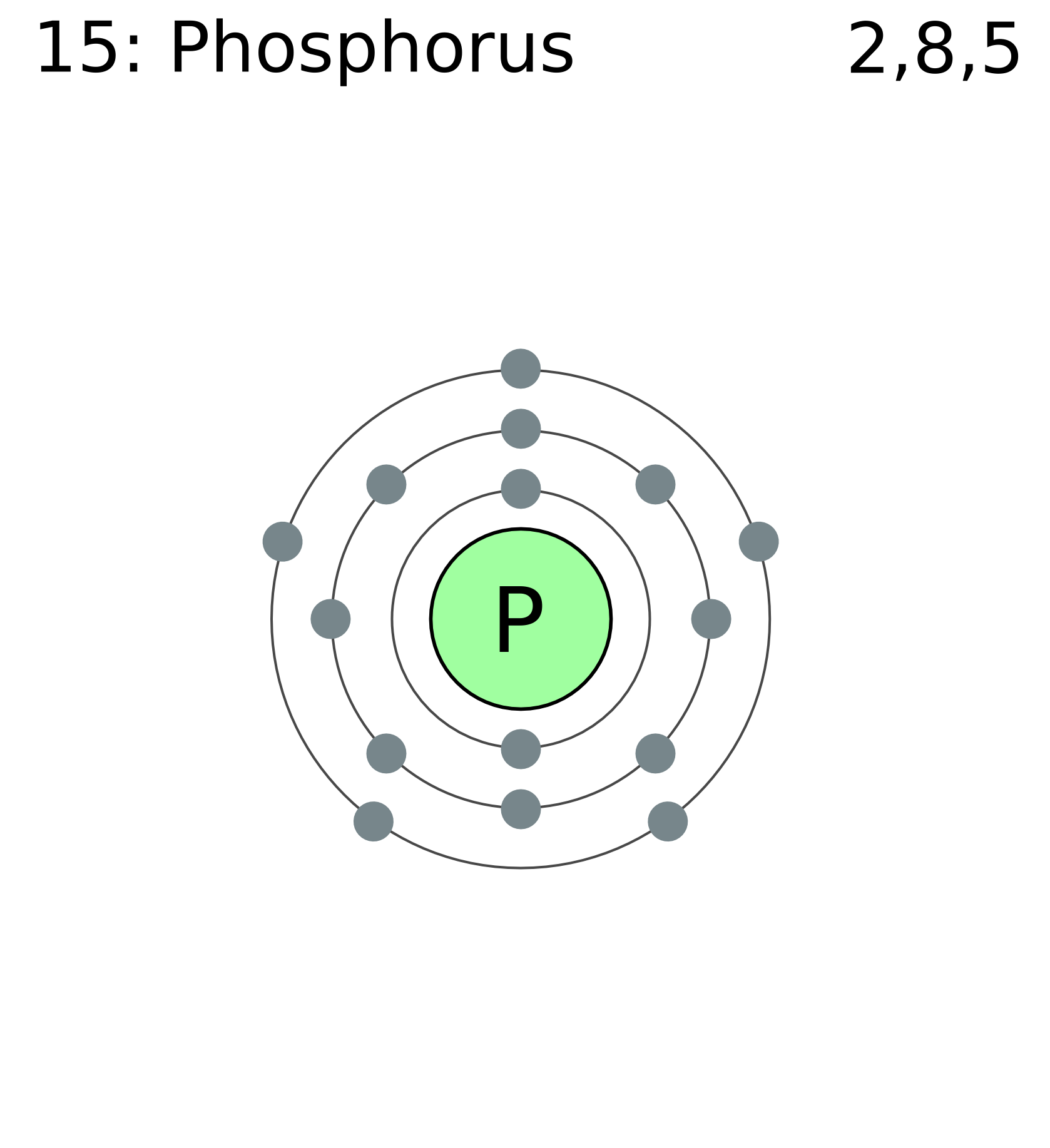
- Element Symbol: P
- Atomic Number: 15
- Group: Group 15
- Classification: Reactive Nonmetal
- Block: p-block
- Electron Configuration: [Ne]3s2 3p3
- Phase at STP: Solid
- Melting Point: white: 317.3 K (44.15 °C, 111.5 °F)
- Boiling Point: white: 553.7 K (280.5 °C, 536.9 °F)
- Density at STP: 1.823 g/cm3
- Oxidation States: +5, +4, +3+2, +2, -1, -2, -3
- Electronegativity (Pauling Scale): 2.19
- Crystal Structure: Body-Centered Cubic
- Magnetic Ordering: Diamagnetic
- Discovery: Hennig Brand (1669)
Atomic Number: 15
"Phosphorus is a chemical element with symbol P and atomic number 15. Elemental phosphorus exists in two major forms, white phosphorus and red phosphorus, but because it is highly reactive, phosphorus is never found as a free element on Earth. It has a concentration in the Earth's crust of about one gram per kilogram (compare copper at about 0.06 grams). With few exceptions, minerals containing phosphorus are in the maximally oxidized state as inorganic phosphate rocks."
Elemental Phosphorus
"Elemental phosphorus was first isolated (as white phosphorus) in 1669 and emitted a faint glow when exposed to oxygen – hence the name, taken from Greek mythology, meaning "light-bearer" (Latin Lucifer), referring to the "Morning Star", the planet Venus (or Mercury). The term "phosphorescence", meaning glow after illumination, derives from this property of phosphorus, although the word has since been used for a different physical process that produces a glow. The glow of phosphorus is caused by oxidation of the white (but not red) phosphorus — a process now called chemiluminescence. Together with nitrogen, arsenic, antimony, and bismuth, phosphorus is classified as a pnictogen."