Element Name: Aluminium
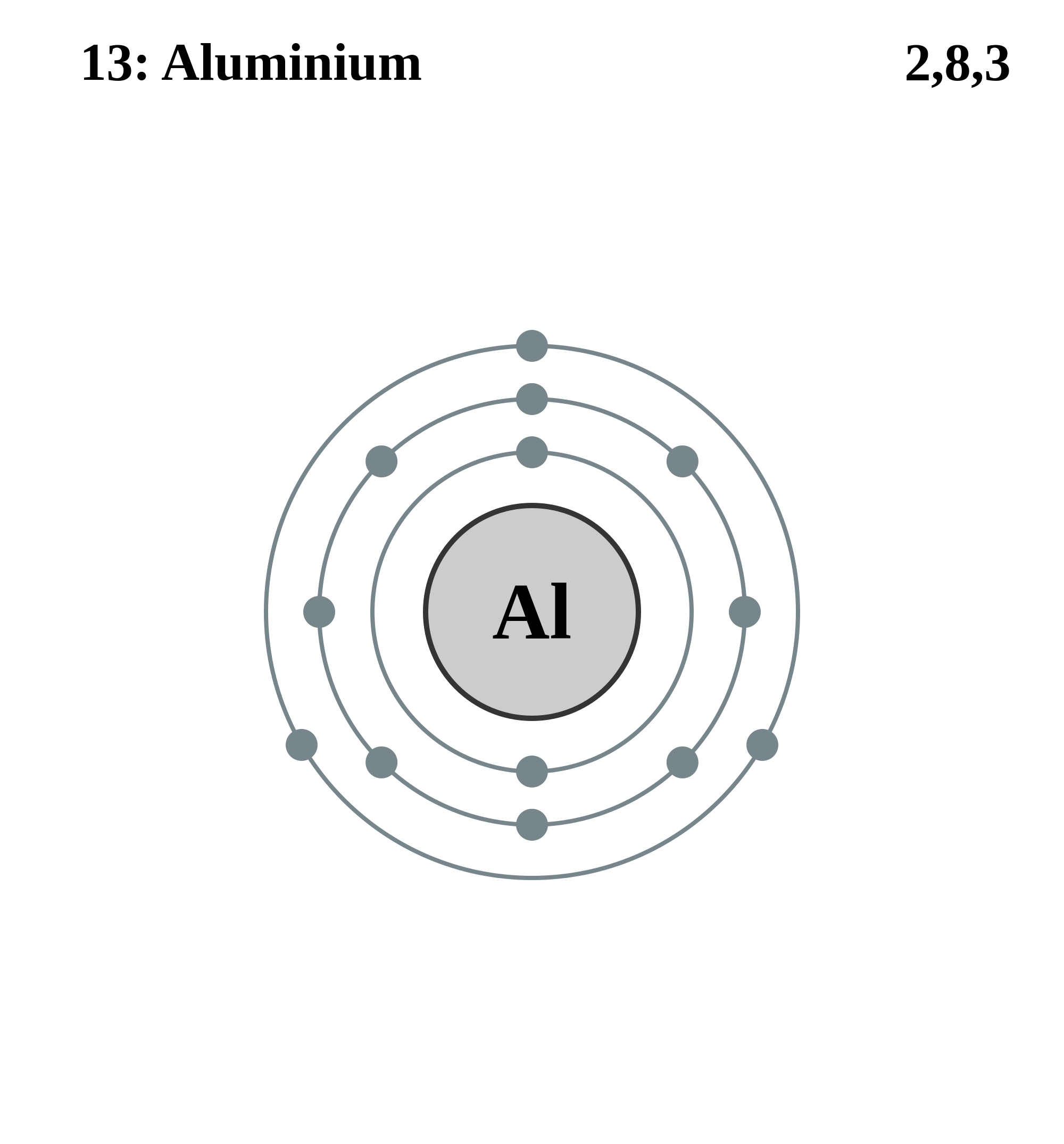
- Element Symbol: Al
- Atomic Number: 13
- Group: Group 13
- Classification: Post-Transition Metal
- Block: p-block
- Electron Configuration: [Ne]3s2 3p1
- Phase at STP: Solid
- Melting Point: 933.47 K (660.32 °C, 1220.58 °F)
- Boiling Point: 2743 K (2470 °C, 4478 °F)
- Density at STP: 2.70 g/cm3
- Oxidation States: +3, +2, +1, -1, -2
- Electronegativity (Pauling Scale): 1.61
- Crystal Structure: Face-Centered Cubic
- Magnetic Ordering: Paramagnetic
- Discovery & First Isolation: Hans Christian Ørsted (1824)
- Named By: Humphry Davy (1812)
Atomic Number: 13
"Aluminium's atomic number is 13. Of aluminium isotopes, only one is stable: 27Al. This is consistent with the fact aluminium's atomic number is odd. It is the only isotope that has existed on Earth in its current form since the creation of the planet. It is essentially the only isotope representing the element on Earth, which makes aluminium a mononuclidic element and practically equates its standard atomic weight to that of the isotope. Such a low standard atomic weight of aluminium has some effects on the properties of the element."
Free Aluminium
"A free aluminium atom has a radius of 143 pm. With the three outermost electrons removed, the radius shrinks to 39 pm for a 4-coordinated atom or 53.5 pm for a 6-coordinated atom. At standard temperature and pressure, aluminium atoms (when not affected by atoms of other elements) form a face-centered cubic crystal system bound by metallic bonding provided by atoms' outermost electrons; hence aluminium (at these conditions) is a metal. This crystal system is shared by some other metals, such as lead and copper; the size of a unit cell of aluminium is comparable to that of those other metals."