Element Name: Sulfur
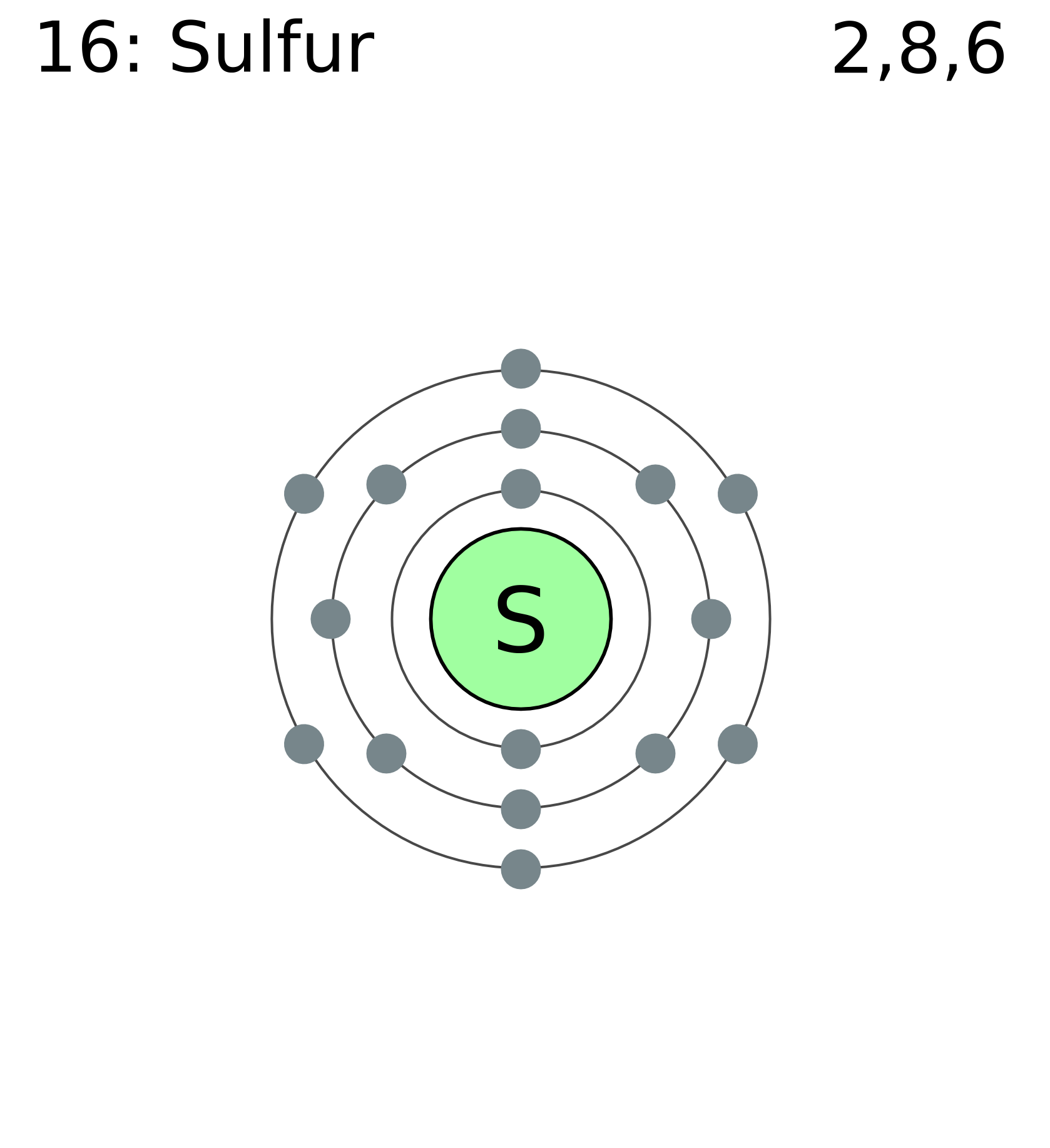
- Element Symbol: S
- Atomic Number: 16
- Group: Group 16
- Classification: Reactive Nonmetal
- Block: p-block
- Electron Configuration: [Ne]3s2 3p4
- Phase at STP: Solid
- Melting Point: 388.36 K (115.21 °C, 239.38 °F)
- Boiling Point: 717.8 K (444.6 °C, 832.3 °F)
-
Density at STP: alpha: 2.07 g/cm3
beta: 1.96 g/cm3
gamma: 1.92 g/cm3
- Oxidation States: +6, +5, +4,+3, +2, +1, -1, -2
- Electronegativity (Pauling Scale): 2.58
- Crystal Structure: Orthorhombic
- Magnetic Ordering: Diamagnetic
- Discovery: Chinese (before 2000 BCE)
Atomic Number: 16
"Sulfur or sulphur is a chemical element with symbol S and atomic number 16. It is abundant, multivalent, and nonmetallic. Under normal conditions, sulfur atoms form cyclic octatomic molecules with a chemical formula S8. Elemental sulfur is a bright yellow crystalline solid at room temperature. Chemically, sulfur reacts with all elements except for gold, platinum, iridium, tellurium, and the noble gases."
Common Smelly Eggs
"Sulfur is the tenth most common element by mass in the universe, and the fifth most common on Earth. Though sometimes found in pure, native form, sulfur on Earth usually occurs as sulfide and sulfate minerals. Being abundant in native form, sulfur was known in ancient times, being mentioned for its uses in ancient India, ancient Greece, China, and Egypt. In the Bible, sulfur is called brimstone. Today, almost all elemental sulfur is produced as a byproduct of removing sulfur-containing contaminants from natural gas and petroleum. The greatest commercial use of the element is the production of sulfuric acid for sulfate and phosphate fertilizers, and other chemical processes. The element sulfur is used in matches, insecticides, and fungicides. Many sulfur compounds are odoriferous, and the smells of odorized natural gas, skunk scent, grapefruit, and garlic are due to organosulfur compounds. Hydrogen sulfide gives the characteristic odor to rotting eggs and other biological processes."