Element Name: Nitrogen
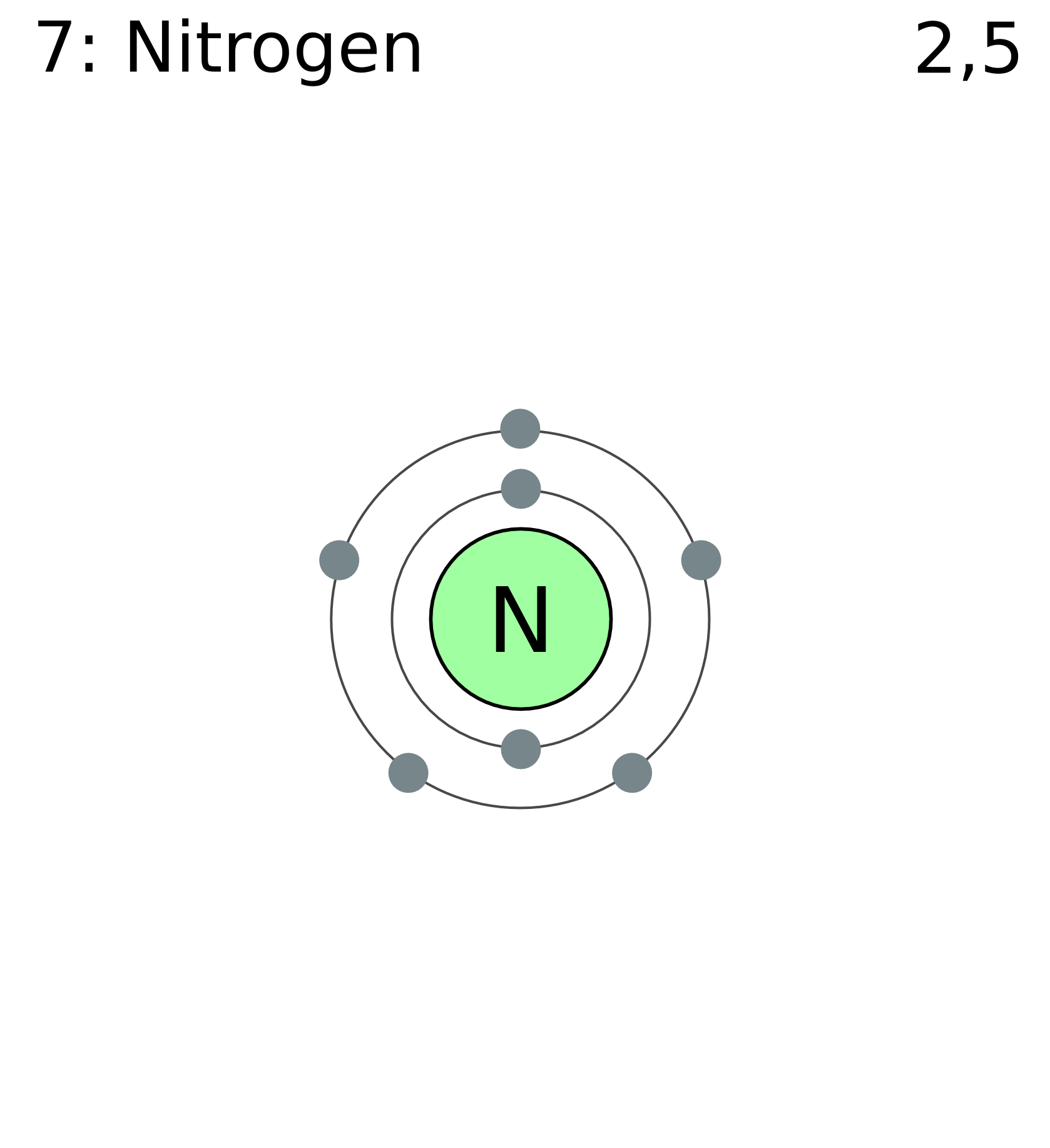
- Element Symbol: N
- Atomic Number: 7
- Group: Group 15
- Classification: Reactive Nonmetal
- Block: p-block
- Electron Configuration: [He]2s2 2p3
- Phase at STP: Gas
- Melting Point: 63.15 K (−210.00 °C, −346.00 °F)
- Boiling Point: 77.355 K (−195.795 °C, −320.431 °F)
- Density at STP: 1.2504 g/L at 0 °C, 1013 mbar
- Oxidation States: 5, 4, 3, 2, 1, −1, −2, −3
- Electronegativity (Pauling Scale): 3.04
- Crystal Structure: Hexagonal
- Magnetic Ordering: Diamagnetic
- Discovery: Daniel Rutherford (1772)
- Nmaed By: Jean-Antoine Chaptal (1790)
Atomic Number: 7
"Nitrogen is a chemical element with symbol N and atomic number 7. It was first discovered and isolated by Scottish physician Daniel Rutherford in 1772. Although Carl Wilhelm Scheele and Henry Cavendish had independently done so at about the same time, Rutherford is generally accorded the credit because his work was published first. The name nitrogène was suggested by French chemist Jean-Antoine-Claude Chaptal in 1790, when it was found that nitrogen was present in nitric acid and nitrates. Antoine Lavoisier suggested instead the name azote, from the Greek άζωτικός "no life", as it is an asphyxiant gas; this name is instead used in many languages, such as French, Russian, and Turkish, and appears in the English names of some nitrogen compounds such as hydrazine, azides and azo compounds."
Lightest in Group
"Nitrogen is the lightest member of group 15 of the periodic table, often called the pnictogens. The name comes from the Greek πνίγειν "to choke", directly referencing nitrogen's asphyxiating properties. It is a common element in the universe, estimated at about seventh in total abundance in the Milky Way and the Solar System. At standard temperature and pressure, two atoms of the element bind to form dinitrogen, a colourless and odorless diatomic gas with the formula N2. Dinitrogen forms about 78% of Earth's atmosphere, making it the most abundant uncombined element. Nitrogen occurs in all organisms, primarily in amino acids (and thus proteins), in the nucleic acids (DNA and RNA) and in the energy transfer molecule adenosine triphosphate. The human body contains about 3% nitrogen by mass, the fourth most abundant element in the body after oxygen, carbon, and hydrogen. The nitrogen cycle describes movement of the element from the air, into the biosphere and organic compounds, then back into the atmosphere."