Element Name: Carbon
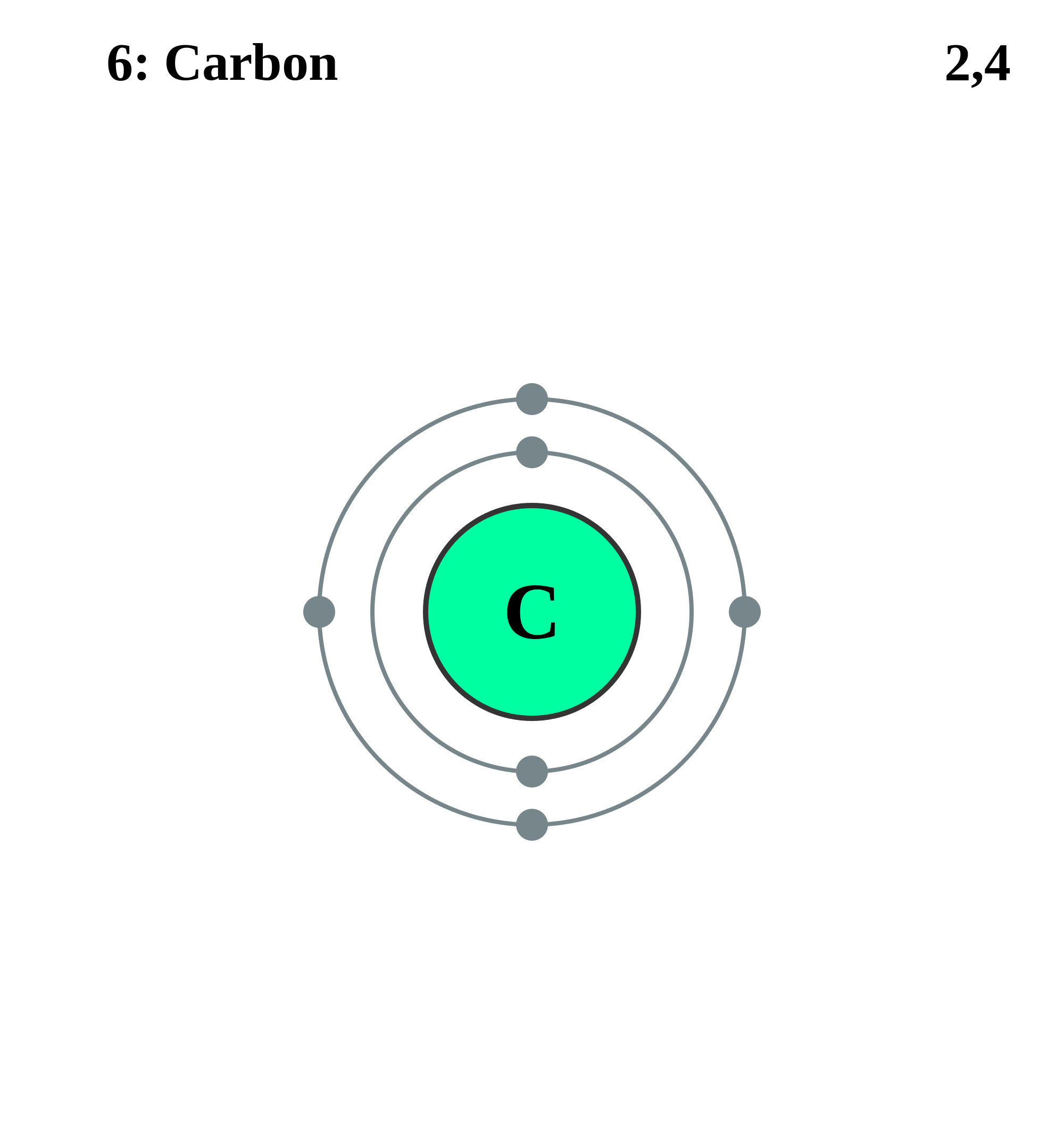
- Element Symbol: C
- Atomic Number: 6
- Group: Group 14
- Classification: Reactive Nonmetal
- Block: p-block
- Electron Configuration: 2s2 2p2
- Phase at STP: Solid
- Sublimation Point: 3915 K (3642 °C, 6588 °F)
-
Density at STP: amorphous: 1.8–2.1 g/cm3
graphite: 2.267 g/cm3
diamond: 3.515 g/cm3 - Oxidation States: +4, +3, +2, +1, 0, −1, −2, −3, −4
- Electronegativity (Pauling Scale): 2.55
-
Crystal Structure: Graphite: Simple Hexagonal
Diamond: Face-Centeres Diamond-Cubic - Magnetic Ordering: Diamagnetic
- Discovery: Egyptians and Sumerians (3750 BCE)
- Recognized By: Antoine Lavoisier (1789)
Atomic Number: 6
Carbon (from Latin: carbo "coal") is a chemical element with symbol C and atomic number 6. It is nonmetallic and tetravalent—making four electrons available to form covalent chemical bonds. It belongs to group 14 of the periodic table. Three isotopes occur naturally, 12C and 13C being stable, while 14C is a radionuclide, decaying with a half-life of about 5,730 years. Carbon is one of the few elements known since antiquity.
Mass Abundance
Carbon is the 15th most abundant element in the Earth's crust, and the fourth most abundant element in the universe by mass after hydrogen, helium, and oxygen. Carbon's abundance, its unique diversity of organic compounds, and its unusual ability to form polymers at the temperatures commonly encountered on Earth enables this element to serve as a common element of all known life. It is the second most abundant element in the human body by mass (about 18.5%) after oxygen.