Element Name: Hydrogen
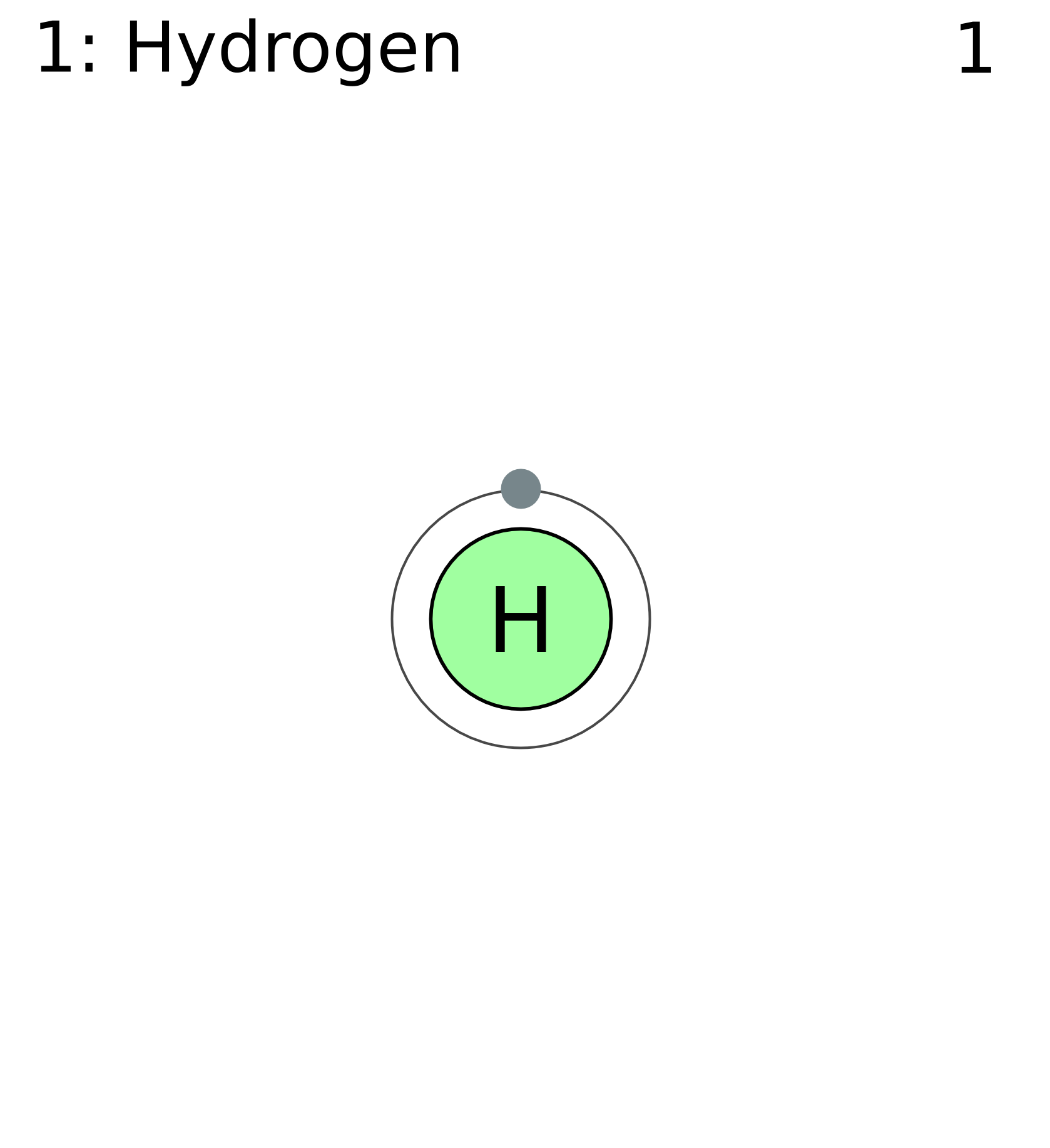
- Element Symbol: H
- Atomic Number: 1
- Group: Group 1
- Classification: Nonmetal
- Block: s-block
- Electron Configuration: 1s1
- Phase at STP: Gas
- Melting Point: 13.99 K (−259.16 °C, −434.49 °F)
- Boiling Point: 20.271 K (−252.879 °C, −423.182 °F)
- Density at STP: 0.08988 g/L
- Oxidation States: -1, +1
- Electronegativity (Pauling Scale): 2.20
- Crystal Structure: Hexagonal
- Magnetic Ordering: Diamagnetic
- Discovery: Henry Cavendish (1766)
- Named By: Antoine Lavoisier (1783)
Atomic Number: 1
Hydrogen is the first element in the periodic table, meaning it has an atomic number of 1 or 1 proton in each hydrogen atom.
The name of the element comes from the Greek words hydro for "water" and genes for "forming," since hydrogen bonds with oxygen to form water (H2O).
Robert Boyle produced hydrogen gas in 1671 during an experiment with iron and acid, but hydrogen wasn't recognized as an element until 1766 by Henry Cavendish.
Atomic Weight: 1.00794
This makes hydrogen the lightest element. It is so light, the pure element isn't bound by Earth's gravity. So, there is very little hydrogen gas left in the atmosphere. Massive planets, such as Jupiter, consist mainly of hydrogen, much like the Sun and stars. Even though hydrogen, as a pure element, bonds to itself to form H2, it's still lighter than a single atom of helium because most hydrogen atoms don't have any neutrons. In fact, two hydrogen atoms (1.008 atomic mass units per atom) are less than half the mass of one helium atom (atomic mass 4.003).