Element Name: Potassium
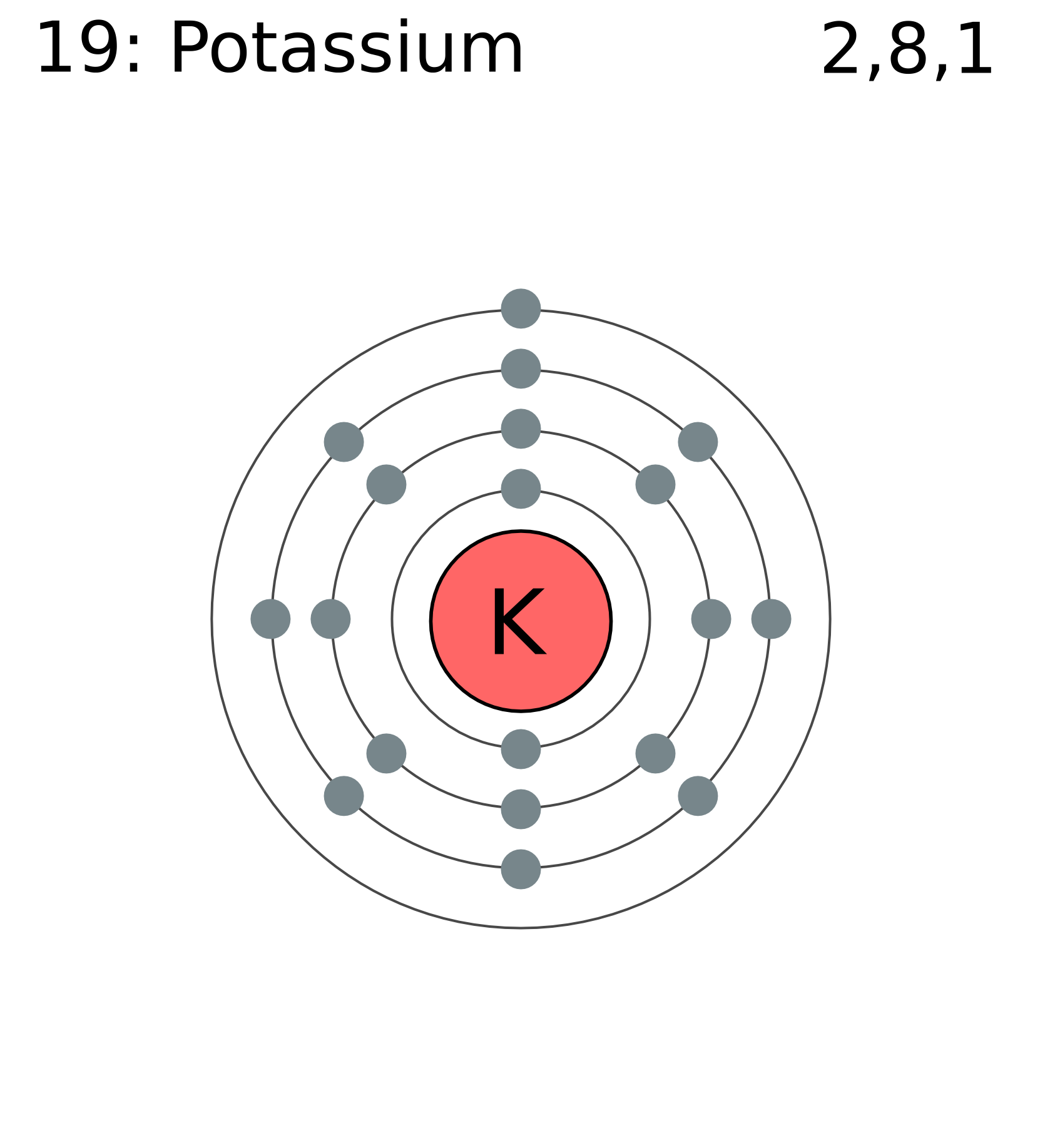
- Element Symbol: K
- Atomic Number: 19
- Group: Group 1
- Classification: Alkali Metal
- Block: s-block
- Electron Configuration: [Ar]4s1
- Phase at STP: Solid
- Melting Point: 336.7 K (63.5 °C, 146.3 °F)
- Boiling Point: 1032 K (759 °C, 1398 °F)
- Density at STP: 0.862 g/cm3
- Oxidation States: +1, 1
- Electronegativity (Pauling Scale): 0.82
- Crystal Structure: Body-Centered Cubic
- Magnetic Ordering: Paramagnetic
- Discovery & First Isolation: Humphry Davy (1807)
Atomic Number: 19
"Potassium is a chemical element with symbol K (from Neo-Latin kalium) and atomic number 19. It was first isolated from potash, the ashes of plants, from which its name derives. In the periodic table, potassium is one of the alkali metals. All of the alkali metals have a single valence electron in the outer electron shell, which is easily removed to create an ion with a positive charge – a cation, which combines with anions to form salts. Potassium in nature occurs only in ionic salts. Elemental potassium is a soft silvery-white alkali metal that oxidizes rapidly in air and reacts vigorously with water, generating sufficient heat to ignite hydrogen emitted in the reaction, and burning with a lilac-colored flame. It is found dissolved in sea water (which is 0.04% potassium by weight), and is part of many minerals."
Radioactivity
"Potassium is chemically very similar to sodium, the previous element in group 1 of the periodic table. They have a similar first ionization energy, which allows for each atom to give up its sole outer electron. That they are different elements that combine with the same anions to make similar salts was suspected in 1702, and was proven in 1807 using electrolysis. Naturally occurring potassium is composed of three isotopes, of which 40K is radioactive. Traces of 40K are found in all potassium, and it is the most common radioisotope in the human body."